CLUB DE L'ARBITRAGE


“LOYAUTE DE LA PREUVE” AND FAIRNESS IN THE TAKING OF EVIDENCE IN INTERNATIONAL ARBITRATION: A COMPARATIVE PERSPECTIVE
The Club de l'arbitrage's abstract
By Tiffany MATTERN-THIAIS, Club de l’arbitrage's communications manager and dispute resolution enthusiast
Wednesday, March 25, 2026
On 25 March 2026, from 4:30 to 6:30 pm, at OCA, as part of Paris Arbitration Week, the Club de l’arbitrage organised a conference on “Loyauté de la preuve” and fairness in the taking of evidence in international arbitration: a comparative perspective.
On this occasion, the panel, moderated by Natalia Gaucher, president of the Club de l’arbitrage, brought together different perspectives and sparked a rich discussion on the role and treatment of evidence in international arbitration.
The discussion explored the role of evidence in international arbitration, focusing on the relationship between loyauté de la preuve and procedural fairness. It emphasized that the key issue is not only the existence or relevance of evidence, but also the conditions under which it is obtained, produced, and challenged. Arbitration was presented as a system that balances competing principles, including the right to proof, equality of arms, adversarial process, and efficiency.
From a comparative standpoint, Professor Denis Mouralis explained that French law historically distinguished between unlawful evidence and disloyal evidence, the latter being obtained through unfair means such as fraud or stratagem. However, the Cour de cassation’s decisions of 22 December 2023 have aligned these categories, allowing such evidence to be admitted where it is necessary for the exercise of the right to proof and proportionate to competing rights. While arbitral tribunals are not strictly bound by these rulings, they reflect a broader evolution in favour of the right to proof. Arbitrators must nonetheless ensure compliance with fundamental principles such as contradiction, proportionality, and respect for privileges, including attorney-client confidentiality.
Obioma Ofoego presented the common law perspective, where evidentiary issues are primarily addressed through the overarching requirement of procedural fairness rather than strict admissibility rules. Under section 33 of the Arbitration Act 1996, tribunals must act fairly and ensure that each party has a reasonable opportunity to present and challenge its case. In this context, cross-examination is essential: if a key issue—particularly involving dishonesty—is not put to a witness, an award may be set aside, as fairness requires that parties be able to confront decisive elements of the case.
The panel also addressed practical aspects of evidence-taking. From the parties’ perspective, Romain Sellem highlighted that fairness begins well before the hearing, through document preservation, internal organisation, and compliance with production orders. In practice, companies often face structural difficulties in retrieving older or decentralised data, which may nonetheless be perceived as a lack of cooperation if not properly documented.
From the expert’s perspective, Mikael Ouaniche emphasized the need for independence despite being appointed by a party. Experts are expected to assist the tribunal, which requires methodological transparency, integrity in data selection, intellectual honesty—particularly in acknowledging uncertainty—and full disclosure of any conflicts of interest.
Practical examples discussed during the panel illustrated the complexity of these issues. In Amadou Diakité v. FIFA, the tribunal accepted evidence obtained through questionable means in light of overriding public interest considerations, showing a form of proportionality similar to the French approach. Other examples highlighted disputes over incomplete or selectively produced documents, the use of materials from criminal proceedings, and the refusal to provide original recordings underlying transcripts, all raising concerns about the parties’ ability to effectively challenge the evidence.
Finally, the discussion underscored the importance of procedural tools such as cross-examination, joint expert statements, and concurrent expert testimony in testing the reliability of evidence. These mechanisms are essential to ensure transparency, reveal inconsistencies, and support the tribunal’s assessment.
Overall, the panel demonstrated that evidentiary issues are not merely technical but lie at the heart of procedural justice in international arbitration, requiring a careful balance between the right to proof and the guarantees of fairness.
The event gathered a diverse audience composed of members of the Club de l’arbitrage and the broader international arbitration community from around the world, including arbitrators, counsel, experts, and in-house lawyers.
Readers are warmly invited to continue reflecting on these issues and to contribute to the development of arbitration law and culture by becoming a member of the Club de l’arbitrage: https://www.clubdelarbitrage.com/en/adhesion.
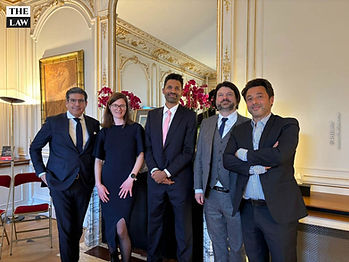
Many thanks to The Law for the picture!